Acreage homes and remodels in Lowry Crossing.
Lowry Crossing is a small town of large lots near the East Fork, with houses a generation older than its neighbors’. We build new homes on its acreage, and remodel and extend the 1980s to 2000s houses already there.
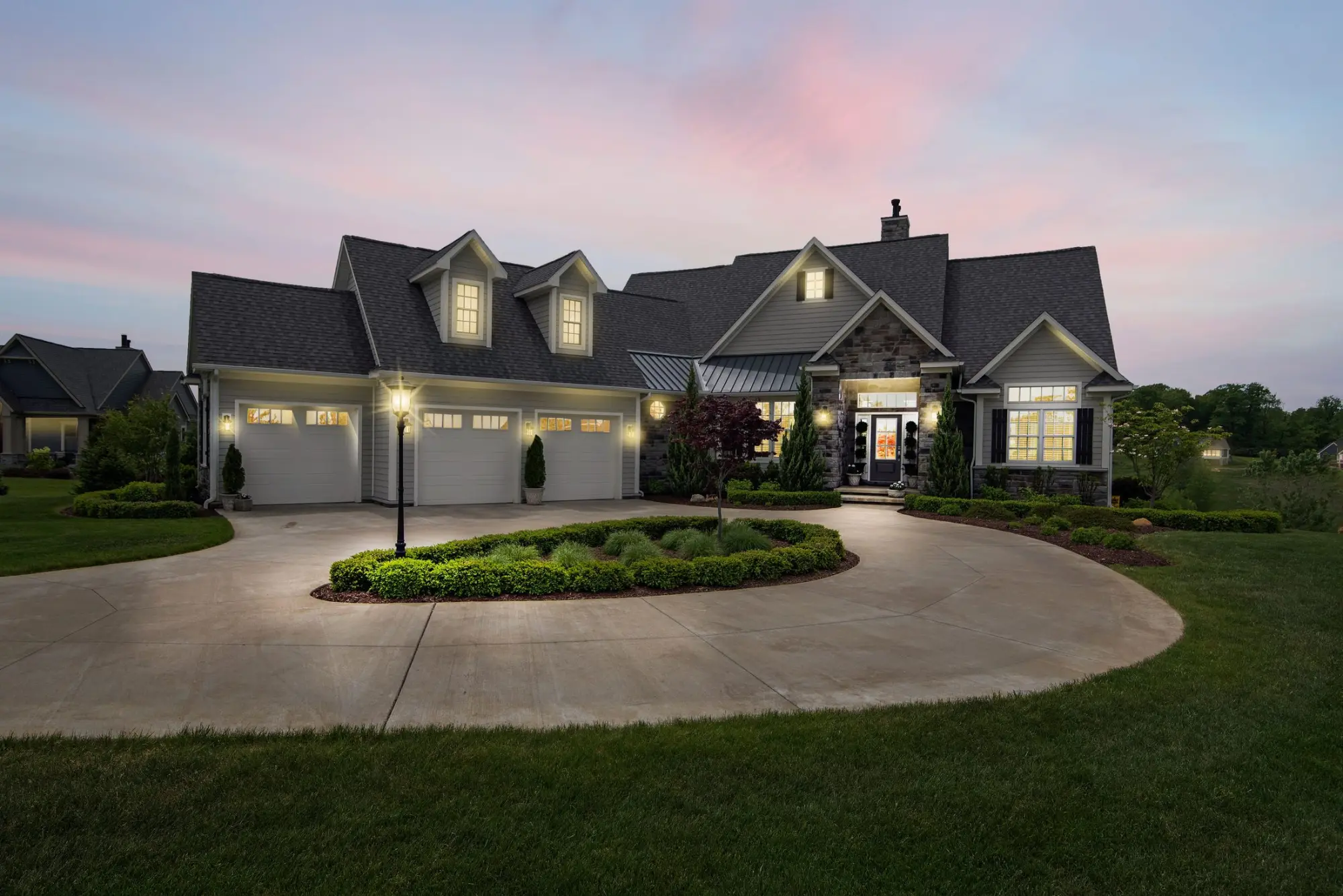
Reference image · Transitional estate home at dusk
Introduction
In Lowry Crossing the houses are older and the lots are wide, so there is room to add rather than replace.
The town sits near the East Fork of the Trinity River, on FM 546 about six miles southeast of McKinney, and over the years it has gone by Lowry, Biggers, Bishop and East Fork. It grew slowly, from 443 people in 1980 to 1,229 in 2000 and about 1,700 through 2010 and 2020. In 2020 its roughly 500 homes shared 2.6 square miles, about three acres of land for each.
Most of its houses date from the 1980s, 1990s and 2000s, largely custom and semi-custom homes on big lots, and the median was built in 1994, twenty years before Princeton’s. They are ready for whole-house remodels, primary suites, bigger kitchens, garages and shop buildings. New housing has arrived quickly since 2023, and the town’s estimated population reached 2,521 in 2025.
At a glance
Lowry Crossing at a glance.
Lowry Crossing lies east of our studio, beyond McKinney on FM 546, between McKinney and Princeton.
- From our studio
- 11.5 miles east of our studio (about 14 miles by road)
- County
- Collin County
- ZIP codes
- 75069, 75407
- School districts
- McKinney ISD, Princeton ISD
- Population
- 1,689 (2020 Census)
What we do here
Building on Lowry Crossing land.
Five kinds of work, each shaped by large lots, older houses and the low ground of the East Fork.
Custom Homes
New homes on acreage, and rebuilds where an older house has reached its end, sited after we check the floodplain along the East Fork and, on the lowest ground, the line of any Lavon Lake flowage easement.
Remodeling
Additions are the natural answer on lots this size: a primary suite, a larger kitchen, a wider garage or a separate shop. We plan them around the framing, roof lines and foundation of the 1980s and 1990s house already in place.
Renovation
Houses thirty and forty years old renewed throughout: windows, doors, flooring, trim and siding, and the wiring, plumbing and insulation updates that come with that age.
Kitchens & Baths
Kitchens and baths in houses built from the 1980s to the 2000s, rebuilt in full, with the plan reworked where a room can borrow space from the next one or from an addition.
Outdoor Living
On lots this large, outdoor living can be generous: long covered patios, pools, outdoor kitchens and pergolas, with drainage planned for the land’s fall toward the East Fork. The city issues a pool permit only after Collin County Development Services has issued one.
What to know
Before building in Lowry Crossing: the land.
In a small town upstream of Lavon Lake, the questions start with the ground itself and then turn to City Hall and the county. We answer them by address before design.
Land, water and rules
Building permits from City Hall
Lowry Crossing issues its own building permits at City Hall on Bridgefarmer Road, for additions, accessory buildings, decks, patio covers, carports, windows, water heaters, fences, foundation repair, driveways and electrical, plumbing and HVAC work. A building permit is void if work does not start within six months or stops for six months.
Contractors on file at City Hall
Lowry Crossing requires every contractor to register with City Hall before working in town, on a form returned with a copy of the contractor’s license. The form covers general, plumbing, electrical, HVAC, irrigation and fence contractors, among others, so it is worth asking whether yours is on file.
Septic, water and sewer
Collin County, not the city, permits and inspects septic systems in Lowry Crossing, so adding or altering a structure, or building a pool, on a lot with an existing system needs a county review of it. Water comes from Milligan Water Supply, and the new Simpson Crossing subdivision is on City of Princeton sewer.
Lavon Lake flowage easements
Around Lavon Lake, the federal government holds perpetual flowage easements on private land, generally below the 509-foot contour, though each deed governs. Homes, fill and most structures are barred there without the District Engineer’s written approval, even when a later deed leaves the easement out.
U.S. Army Corps of Engineers: know your boundaries at Lavon Lake
What the easement allows
Mowing, planting and fences up to the government line are allowed on easement land. A septic or sewer line there needs the Corps’ review, and state rules keep a septic system at least 75 feet upslope of the 50-year flood contour. The Lavon Lake Office answers questions at 972-442-3141.
U.S. Army Corps of Engineers: know your boundaries at Lavon Lake
The East Fork bottomland
The East Fork’s low ground drains south into Lavon Lake, and land along it is floodplain. We check a lot’s elevation and the flood mapping before siting a house, a pool or an addition, because a few feet of grade can decide where each one goes.
Clay and drainage
The prairie clay here rises as it soaks up rain and drops back as it dries. On a big lot, the answer is a foundation engineered for the soil, ground graded away from the house, and gutters and flatwork that carry water to where the land can take it.
Two school districts
Lowry Crossing is split between McKinney ISD and Princeton ISD. For a family planning a new home, the district line can matter as much as the lot itself, so it is worth checking the district’s own boundary map before buying land.
Neighborhoods
Lowry Crossing, part by part.
The town divides most clearly by the age of its houses and the lay of the land.
- Acreage homes of the 1980s and 1990s
- Half the town’s houses, on large lots, built when Lowry Crossing first grew. Whole-house remodels, primary-suite additions, and windows, trim and siding renewed.
- Houses of the 2000s
- About a third of the town, custom and semi-custom homes now around twenty years old. Kitchens, baths, outdoor living and the first round of exterior upkeep.
- The oldest houses
- About one in eight homes dates from the 1960s and 1970s. Updates to wiring, plumbing and insulation, and testing before old ceiling texture or flooring is disturbed.
- Near the East Fork
- Lower ground draining toward Lavon Lake. Building here starts with flood mapping and, on the lowest land, the Corps easement line, which can limit where a house, pool or shed may go.
- New homes since 2023
- The newest houses in town, arriving as the population grew by about half in two years. Patios, pergolas, fencing and pools come first on these lots.
Lux Domus Builder
VI · How it unfolds
From the first visit in Lowry Crossing to the keys.
01
Consultation
We meet at your home or lot in Lowry Crossing, or at our McKinney studio, and talk through the brief, the timing and a budget range.
02
Design
Plans, structure and selections resolved in full, with the scope and price agreed, before work begins.
03
Approvals
Permits from the City of Lowry Crossing and any HOA architectural review, prepared, submitted and followed through.
04
Build and handover
One managed schedule, regular site walks and plain updates, then a careful walkthrough and every punch-list item closed.
Questions
Building in Lowry Crossing: questions.
Does the Lavon Lake flowage easement affect land in Lowry Crossing?
Only if your land lies within it. The easements cover private land around the lake, generally below the 509-foot contour, and the deed governs. Homes, fill and most structures are barred there without the Corps’ written approval, even if your current deed does not mention it, so we check before design.
Who issues building permits in Lowry Crossing?
City Hall does, for work from additions, decks and patio covers to windows, water heaters, fences and foundation repair, and every contractor must be registered with the city. Septic systems go through Collin County, and a pool needs a county permit before the city will issue one. We prepare the applications alongside the drawings and add any Corps review the land calls for.
Can I add on to my 1980s house in Lowry Crossing?
On most lots here there is room to. An addition is planned around the existing structure, roof lines and foundation, and around the lot’s drainage and any floodplain. A primary suite, a larger kitchen and a garage or shop are the typical choices.
Which school district serves my Lowry Crossing home?
The town is split between McKinney ISD and Princeton ISD, so it depends on the address. Check the district’s own boundary map before buying land or planning a move, since the line runs through the town.
Can we meet on my land?
Yes, and on acreage it is where we would start. The slope of the land, its drainage and the way in from the road decide where a house or addition goes, and walking it first settles many design questions before any drawing.
Nearby
Near Lowry Crossing as well.
The closest places we serve, with miles from our McKinney studio. See every place on the map.

Handyman
Smaller jobs in Lowry Crossing, booked online.
TV mounting, fixtures, doors, drywall, fences and the rest of the list, at upfront prices, in an arrival window you choose.
Nearby
- 13.4PrincetonCustom homes, remodeling and renovation in Princeton · 13.4 miles east of our studio
- 8.5FairviewCustom homes, remodeling and renovation in Fairview · 8.5 miles southeast of our studio
- 11.6LucasCustom homes, remodeling and renovation in Lucas · 11.6 miles southeast of our studio
- 4.4McKinneyCustom homes, remodeling and renovation in McKinney · Home to our studio, in west McKinney
- 12.1MelissaCustom homes, remodeling and renovation in Melissa · 12.1 miles northeast of our studio
- 7.6AllenCustom homes, remodeling and renovation in Allen · 7.6 miles southeast of our studio
Lux Domus Builder
Begin with a conversation in Lowry Crossing.
A private consultation is the first step of every project, whether you are planning a new home, reshaping the one you have or bringing it up to date.
Headquartered in McKinney, Texas (214) 892 5228 [email protected]